
Talking Through Slang: Teaching Our Kids to Think Biblically
As the kids have gotten older, they’ve come home using new words and phrases. Some of them we’ve recognized and some of them leave us scratching our heads.
Many times it’s harmless. Not every new slang word or phrase is cause for suspicion, but sometimes, a pause is warranted.
In the last couple of months, there’s been a few times my radar has gone off, and I’ve made a point to have a conversation with whoever is using it.
The goal isn’t to make them feel bad or judge who they heard it from, but to teach them to slow down, think things through, and learn how to filter what they hear through God’s Word.
So far, our conversations have gone well and they’re receptive once we break a few things down.
In case anyone else finds themselves in the same boat, I thought I’d share how I handle talking through slang and why.
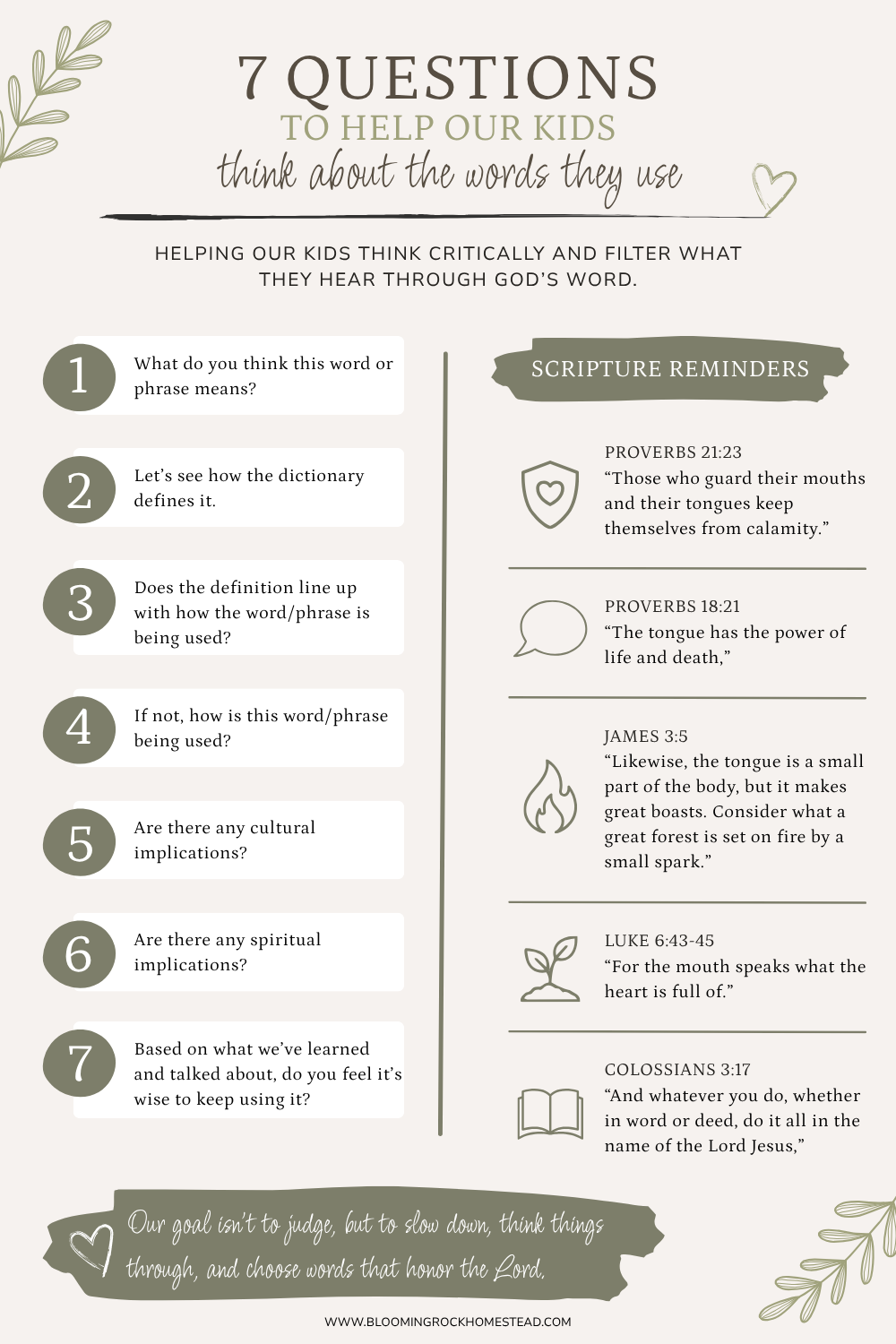
P.S. If these questions would be helpful for your family too, there’s a free printable waiting for you at the bottom of this post.
- What do you think this word or phrase means?
- Let’s see how the dictionary defines it.
- Does the definition line up with how the word/phrase is being used?
- If not, how is it being used?
- Are there any cultural implications with the word/phrase?
- Are there any spiritual implications with the word/phrase?
- Based on what we’ve learned and talked about do you feel it’s wise to keep using it?
Let’s break this down a little more with the most recent slang word we’ve talked through: aura.
What do you think this word or phrase means?
Their answer was no. They had no idea what it meant, but a lot of other kids were saying it. I like to take these opportunities to chat about whether it’s wise to say and/or do something just because someone else is doing it and/or because they wanted to fit in.
As adults, we have the foresight to know those actions can often lead to trouble and/or people pleasing traits. Hard things to break once patterns set in.
In our house, we like to encourage our kids to be ok with looking different. The entirety of Jesus’ ministry on earth was just that, being and doing things different – going against the grain. So we often have side conversations on how difficult this can be, how God knew it would be difficult for us, and that’s why His Word was given to us.
Let’s see how the dictionary defines it.
1. noun: a distinctive quality or atmosphere that seems to surround someone or something; slang: the quality of being impressively cool, charming, or appealing
2. Medical: a subjective sensation (as of voices, colored lights, or crawling and numbness) experienced at the onset of a neurological condition
3. an energy field that is held to emanate from a living being
4. a luminous radiation
‘Cool’ factor; star power; stylish swagger
Where does aura come from?
The slang meaning of aura stems from the word’s sense meaning “a distinctive atmosphere or quality someone or something is felt to emanate”—that is, the energy or ‘vibe’ given off.
It spread online in the early 2020s, especially in reference to athletes exhibiting prowess in their sport. In summer 2024, aura went viral on social media, especially TikTok, often in connection to a video trend in which people playfully quantified how many so-called aura points someone gained or lost relative to variously smooth or awkward social scenarios.
Mostly the same as Merriam Webster, but with this addition, “Classical Mythology: a companion of Artemis who bore twins to Dionysus. Zeus changed her into a spring because, in a fit of madness, she had killed one of her children.”
This is always an interesting one. People can add their own words. I didn’t show this to my child for that very reason. But, when looking up aura, most of the definitions were connected to life energy, spiritual beliefs, or a girl’s personality. It shows the trend.
I take this site with a grain of salt, but it’s sometimes useful for learning how the modern world sees/uses the word. Here it’s defined with mostly paranormal/energetic uses.
Google Search:
Again, this is simply a reference, but sheds more light.
“The word aura originates from the Latin aura, meaning “breeze” or “breath of air,” which was borrowed from the Ancient Greek aúra (αὔρα), signifying a “gentle breeze” or “soft wind.”…
In English, the term first appeared in the late 14th century with its literal meaning of a “gentle breeze.” Its figurative senses evolved over time, including “subtle emanation” in the 18th century, “characteristic impression” in the mid-19th century, and “spiritual energy field” in the late 19th century.”
Does the definition line up with how the original word/phrase is being used?
Some of the newer slang definitions, yes. The original definition, no.
It’s not being used to indicate air qualities.
To make sure we understand exactly what we’re saying and how it may come across to others, let’s take it a step further.
If not, how is it being used?
It might be easy to look at some of the definitions and say, “Oh, well they are using it sort of correctly, so that’s ok.”
But here’s where I like to pause and help them think through: is what’s leaving our mouth actually pleasing and honoring to God?
Depending on the word, we may need to look beyond the modern slang definition and consider how the word has been used in other contexts and what it communicates to different people.
We often do this in Bible studies, so why wouldn’t we slow down and do the same with the words coming out of our own mouths?
From my own experience, especially knowing aura is sometimes used in other religious contexts, this was important.
I also feel it’s important to consider those around us. We live in an area that is diverse with many ethnicities and cultures being represented, so we can’t assume that just because a word means xyz to us it’s being used the same everywhere else.
Are there any cultural implications with the word/phrase?
I recently witnessed an example of something meaning one thing in one culture, but it was actually derogatory in another. It was a situation where many people from all over the world were gathered in one place.
A younger person was sharing a dance they created to a specific song. I’ve never heard the song before, so I don’t know the origin, but some of the lyrics were “pinky up”. Many of us laughed at the antics and enthusiasm. However, after the song, several people from one country explained pinky up (including the physical act of holding a pinky up) was the equivalent to our American version of the middle finger in their culture.
I’m sure that’s not what this young person intended, but it’s a prime example of how different things have different meanings to those with different cultural backgrounds.
I reminded my child of that example, in generic terms of how something meant to be harmless and fun could cause great misunderstanding.
We also talked about how, depending on someone’s religious or spiritual background, the word aura may carry meanings very different from the slang our culture intends.
Using it in front of someone who practices certain types of energy based healing, it could be seen as referencing their energetic field.
Are there any spiritual implications with the word/phrase?
Based on the information learned so far, I shared that I didn’t feel comfortable using the word aura casually (as slang being taken out of context).
My child questioned this wanting to know more, which I actually loved because it gave us a chance to talk about what we know from the Bible.
We touched on I Peter 5:8 which warns us to be sober minded because the devil is roaring around looking for opportunities. If we are blindly repeating what others say and do, we’re bypassing our minds, assuming that our words and actions are ok.
In addition, we now know some of the usage of the word aura holds spiritual meaning, in ways not in accordance with God’s Word. Nowhere in the Bible does it reference people’s spiritual energy fields/auras and we know mythology is based on belief of false gods.
We also talked about how everything we do and SAY should be done for the Lord. (Colossians 3:17)
As Christ followers, we are called to be set apart. Meaning we should act, think, and talk differently than the rest of the world. Our love for God should be constantly on display by honoring Him with literally every aspect of our lives.
Is that a high calling? Even for our young children? Absolutely! But this is where we show and model Philippians 4:13, acknowledging we’ll always fall short on our own (Romans 3:23), so we live set apart using Christ’s power in us.
We’ve also talked with our older children about how certain things can become opportunities for Satan and his evil forces to creep in.
Although I’m sure my child’s intentions were pure in using the word aura, I cannot say the same for Satan. He will use anything and everything to create barriers in our relationship with God.
I will never assume that just because someone does something out of innocence means they’re exempt from spiritual attack. I’ve personally witnessed too much, even in our home, to believe otherwise.
Here are some other verses that might be handy.
Proverbs 21:23 – “Those who guard their mouths and their tongues keep themselves from calamity.”
Proverbs 18:21a – “The tongue has the power of life and death,”
James 3:5-6 “Likewise, the tongue is a small part of the body, but it makes great boasts. Consider what a great forest is set on fire by a small spark. The tongue also is a fire, a world of evil among the parts of the body. It corrupts the whole body, sets the whole course of one’s life on fire, and is itself set on fire by hell.”
Luke 6:43-45 – “No good tree bears bad fruit, nor does a bad tree bear good fruit. Each tree is recognized by its own fruit. People do not pick figs from thornbushes, or grapes from briers. A good man brings good things out of the good stored up in his heart, and an evil man brings evil things out of the evil stored up in his heart. For the mouth speaks what the heart is full of.”
In Titus 2:7-8, the apostle Paul was instructing Titus to show “soundness of speech” in his teaching so that no one would have anything bad to say about Christ followers. In a way, even our children are teachers because just as they look up to those older than them, younger siblings and friends are looking up to them.
Based on what we’ve learned and talked about, do you feel it’s wise to keep using it?
This is where I like to lean into teaching our kiddos to think both independently and critically.
Dependent thinking can lead to following the masses. Not looking at different angles can lead to an ignorance is bliss mentality.
If we are to be sober minded, focused on pleasing the Lord, and setting a Christ-like example, it’s helpful to think and question. Especially when pertaining to worldly things.
So, we end our time together by assessing all that we’ve talked about and looking at it anew.
- What do you think now that we’ve looked into how the word is supposed to be used?
- Does using this word make you look smart or foolish?
- Is how this word is being used pleasing to God?
- Is it possible someone else might misinterpret it and be hurt?
- Could using this word could point someone away from God or discredit your testimony?
- Any other questions?
Usually, it’s almost always felt that the slang word should not continue to be used.
And not because I led by sharing my opinion or bias. I try hard to leave that out and let the kids do the processing.
It’s always a humble reminder for me to not underestimate how God is working in their hearts.
When they ask what to do when people around them continue to use the word, I usually suggest they ignore it or respond with words they know and understand.
It’s not our place to judge or parent other people. It’s our place to set the best example we can by living set apart.
Overall, this process isn’t really about one particular slang word. Next month there might be something new. My hope isn’t to create a growing list of words to avoid. Rather to teach my children how to thoughtfully evaluate what they hear through the lens of Scripture.
It was recently brought to my attention that Jesus often answered questions with His own questions. Rarely, did He provide a straight out answer.
Likewise, this series of questions is meant to help my children do their own thinking.
I would much rather have these sometimes difficult conversations with my kiddos while they are young. It allows us to walk them through it and share our own mistakes.
More importantly, it helps them form thoughts/opinions/beliefs based on their own homework and God’s Word, not just someone else’s word.
Words still slip out sometimes when emotions are high (good and bad), but it’s usually followed by a quick look of chagrin letting me know it was an oops.
At the end of the day, all of us are learning and trying our best together.
Keep These Questions Handy
If you think these questions might come in handy someday, I’ve put together a simple printable you can download below. You can also save the graphic to your phone for quick reference.
Stay Connected!
Encouragement for Faith & Everyday Life
Life can feel full with faith, health, home, and all the small things in between. The newsletter is a simple way to stay connected through new blog posts, encouragement, occasional shop news, and free tools that support intentional, everyday living.
A glimpse of the free tools